

The "Invisible Bra" Breakthrough: Why Women Are Trading the $12,000 Surgeon's Knife For This 15-Minute Nano-Patch
A new transdermal technology is delivering clinical-grade volume and lift directly into breast tissue — bypassing the skin barrier that has made every cream you've ever tried completely useless.
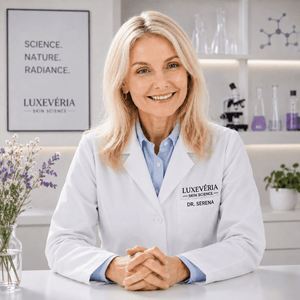
Dr. Simone Hartley — Women's Dermoaesthetics Correspondent Published
June 26,2026

You bend over. And you remember.
The moment you catch a glimpse in the bathroom mirror — not the flattering angle you've learned to find, but the honest one — your breasts look like half-full water balloons, skin pooling where volume used to live. You straighten up, reach for the expensive firming cream on the counter, and apply it like a ritual. Like hope.
That cream will do nothing. You probably already know that. And yet, what's the alternative?
For the 4.7 million American women who complete their breastfeeding journey every year — and for the millions more navigating perimenopausal hormonal shifts — this is the trap: creams that lie, and surgery that terrifies. Until now, there has been nothing in between.
Why Creams Fall Short

Your Skin Is A Barrier — Creams Mostly Stay On Top
Most firming creams sound impressive on the label.
Collagen.
Hyaluronic acid.
Botanical extracts.
Peptides.
Plumping actives.
The ingredients may be real, but the problem is delivery.
Your skin is designed to protect you. The outer layer acts like a wall, keeping many larger molecules from easily passing through. That means a typical cream may soften the surface, but often fails to reach the level where visible firmness and plumping support truly matter.
That is why women spend hundreds of dollars and still feel disappointed.
Not because every cream is useless.
But because rubbing active ingredients on the surface is not the same as delivering them where the skin needs support.
The Real Reason You're Sagging — And It's Not What You Think

Post-pregnancy breast changes aren't primarily a skin problem. They are a structural engineering failure happening two layers deeper. During breastfeeding, hormonal expansion stretches Cooper's Ligaments — the fibrous suspension cables that hold your breast tissue against the chest wall — often beyond their elastic limit. When glandular tissue atrophies after weaning, the skin envelope and ligaments frequently fail to retract. The "insides have been scooped out" — and the skin is left behind.
Layered on top of this, collagen production slows with age, the dermal matrix fragments, and estrogen decline during perimenopause strips density from the skin itself. The result: no internal scaffolding, no volume, no lift.
No cream applied to the surface of your skin can touch any of this. The repair work needs to happen at the dermal level — inside the skin, not on top of it.
Three steps. One patch. Your skin takes in the benefits.
This is more than ordinary topical skincare. It adopts transdermal nano-channel delivery technology, similar to professional salon skin treatment technology, designed for convenient home use.
-

The Doorway Opens
Over 3,000 microscopic dissolvable polymer micro-projections gently reach the outer skin layer, forming temporary invisible micro-channels. These subtle channels help active ingredients bypass the skin’s outer barrier. You will only feel gentle warmth, with no other uncomfortable sensation.
-

The Payload Arrives
As the micro-projections gradually dissolve, dual-peptide actives are delivered into deeper skin layers. The compound blend helps replenish skin volume appearance and support the collagen network that shapes smooth skin contours.
-

Your Skin Improves
The active blend supports improved skin fullness look and helps maintain skin elasticity from within. The patch creates ideal conditions for your skin to boost its own natural radiance and firmer-looking contour.


The Science of the Dual Peptide Payload

Visible Transformation Timeline
-

DAYS 1–14 | FIRST SIGNAL
Active ingredients awaken skin vitality and support improved plump appearance.
79% of users notice visible improvements in skin tautness. Early observations show up to a 12% boost in the visual density of skin tissue.
This is when you begin to perceive visible changes to your skin. -

DAYS 15–28 | VOLUME RETURNS
Steady usage supports natural collagen activity and enhances skin plump look.
Users experience up to 40% improvement in visible bust fullness, with potential enhancement to silhouette. The upper bust area gradually regains a rounded, full appearance. -

DAYS 29–56 | FULL REFINEMENT
The skin’s supportive network gets optimized for smoother contours.
Your bust reaches its most lifted and defined silhouette. The skin’s supporting framework achieves an improved look, delivering lasting refined shape.


Why Neither Old Option Was Good Enough
Before This Nano-Patch, The Choices Felt Too Limited
| Option | Result | Reaches Dermis | Risk & Cost |
|---|---|---|---|
| Traditional Firming Creams |
Surface hydration only |

No |
Low risk, but limited effect. Usually $20–$80 |
| Mechanical Devices / Pumps |
Temporary swelling effect |
No |
May feel uncomfortable or over-stimulating. Usually $100–$300 |
| PRP / Vampire Breast Lift |
Mild volume & collagen support |

Yes |
Requires injections and appointments. Usually $1,000–$2,500 |
| Surgical Mastopexy |
Permanent structural lift |
Yes |
Anesthesia, scarring, and long recovery. Usually $5,000–$15,000 |
| Advanced Nano-Patch Recommended |
Deep dermal volume & lift support |
Yes |
Non-invasive, painless at-home routine. Fraction of surgery cost |
They found their way back, too.
Your Working Body Deserves To Feel Like Yours Again
-

“I was convinced nothing could bring visible improvements without cosmetic procedures. By week two, I noticed obvious differences — my bras fit differently, and even my posture felt changed. By week six, I was truly moved by the shift.”
-

“I have tried countless creams. This is the first item where I noticed promising signs as early as day 12. By week four, my husband spotted the visual difference before I even mentioned it.”
-

“I used to hate getting dressed and always reached for heavy push-up bras. Now I can wear regular tops comfortably without extra shaping support. It sounds like a small change, but it means so much to me.”
-

“The working principle makes sense. The micro-projection design sounds intimidating at first, yet there’s no uncomfortable sensation during use. After two weeks, I began to see a more natural version of myself again.”


Before You Apply The Patch
Does it hurt? I’m anxious about anything with "needle" in the name.
Does it hurt? I’m anxious about anything with "needle" in the name.
The nano micro-projections are microscopic, much finer than standard medical needles. Most users describe application as gentle warmth or mild tingling at most. It will not break the skin, cause bleeding, nor create injection-like sensations. The micro-projections dissolve fully within minutes after application.
How is this different from every other firming patch I’ve seen?
How is this different from every other firming patch I’ve seen?
Most firming patches only carry topical cream held by adhesive, and active ingredients cannot penetrate past the outer skin layer. This nano micro-projection system creates tiny micro-channels on skin, helping active ingredients reach deeper skin layers to support improved skin appearance. This unique delivery method makes all the difference.
Is it safe to use after breastfeeding, or during perimenopause?
Is it safe to use after breastfeeding, or during perimenopause?
Yes. This patch contains no hormones, pharmaceutical ingredients, or phytoestrogens. The dissolvable polymer micro-projections are biocompatible and dissolve completely without leftover residue. Formulated to suit skin conditions post-pregnancy and during perimenopause, periods when visible skin texture changes are commonly noticed.
What if it doesn’t work for me?
What if it doesn’t work for me?
We provide a full 30-day money-back guarantee. If you use the product consistently for 30 days and do not notice improvements in your skin’s firming appearance, reach out to our support team for a full refund. No extra inquiries, no complicated return steps.
Will it increase breast size?
Will it increase breast size?
No. This product should not be described as permanently increasing breast size or changing body structure. It is for cosmetic skin appearance support only.
Is it a medical treatment?
Is it a medical treatment?
No. It is not intended to diagnose, treat, cure, or prevent any medical condition. It is a cosmetic body-care product.
Can I use it on other body areas?
Can I use it on other body areas?
It may be used on suitable body areas that need extra hydration and firmness support. Avoid sensitive areas, mucous membranes, broken skin, or areas close to the eyes.

Your silhouette deserves to feel uniquely yours again.
You’ve given so much of yourself. This skincare patch is designed to give you support in return. Formulated with clinically validated peptides, each patch creates over 3,000 nano-channels for targeted skincare. It features a non-hormonal blend for painless application, dermatologist-tested to deliver hydration, firming and plumping support for your bust area. We offer a 30-Day Money-Back Guarantee, no questions asked. Begin your skincare journey today.

Comments

I ordered after seeing plenty of positive feedback about this microneedle skincare patch. After several uses, I can say my skin looks smoother and feels more hydrated. I’m really happy with the experience!
 15
15

These patches stay secured well overnight, which impressed me! When I wake up, the skin on my bust area appears firmer and refreshed. It fits easily into my daily routine.
10

I was worried the micro-projections might feel uncomfortable, but they feel extremely gentle. I love how hydrated my skin stays, and the plumping effect is a lovely bonus.
16

I appreciate that this patch combines hydration and firming care. The change is not dramatic, yet I can clearly see and feel subtle improvements. My skin looks more refreshed overall.
15

After a couple of weeks, my skin feels softer and better conditioned. I also love the thoughtful, clean packaging; it feels like a premium skincare item.
15

The patches are simple to apply and do not irritate my skin at all. Knowing it has passed dermatologist testing gives me extra confidence to use it.
7

I’m interested but a little skeptical. Are these patches comfortable while sleeping, and can they stay on all night?
4

I wondered the same thing! They are very lightweight and barely noticeable. They stay firmly attached all night and remain intact by morning.
11

I want to add: I love that this product is vegan and cruelty-free. This standard matters a lot to me and made me willing to give it a try.
38

I’m usually cautious about beauty product claims, but these honest, balanced reviews encouraged me to place an order. So far I’m glad I tried it; my skin feels smoother and looks more refreshed.
11