

 By Debby - clinical immunodermatologist
Summary: Most women are told it's one thing. Your blood sugar. Your hormones. A yeast infection. A rash.
So you do everything right. You get your blood sugar under control. Your hormones are treated. The infection clears. The rash fades, and the skin looks fine again.
And still, the itching and burning in your intimate area and groin never leave. And sooner or later, the rash is back too.
That's because the first cause was never the whole story. Whatever started it damaged your skin barrier, the thin protective layer that keeps your intimate skin from drying out, cracking and reacting to everything, and that damage stayed behind long after the cause was gone.
This is why it keeps coming back, and what your skin actually needs.

Different symptoms. One problem.
You may have been given a name for it: a yeast infection, eczema, a rash, "just dryness." Maybe a different name every time. But underneath, most of them come back to the same thing: a skin barrier that's been damaged and never repaired.
Most people tell us it's one of these, or all of them at once:
Itching you can’t get rid of. It comes back no matter what you put on it. It’s worst at night, and scratching only makes it worse. That’s the nerve endings under a damaged barrier, left exposed and firing even when the skin looks fine.
Burning, rawness or weeping skin. Stinging when you pee, wipe or sweat. Skin that feels sanded raw, or turns red, wet and weeping. That’s urine, sweat and friction reaching skin that has lost its protective layer.
Cracked or broken skin. Tiny splits in the folds, at the opening or around the anus that sting and never quite close. That’s a barrier so dried out and worn down that it has started to tear.
Rashes that keep coming back. Heavy rashes, sometimes fungal outbreaks, that clear up with treatment and then return weeks later. Each one leaves the barrier a little more damaged, and damaged skin can’t defend itself.
Or nothing to see at all. No rash, barely any redness, every test negative, and it still itches and burns just as much. The damage sits just under the surface, where no mirror can see it.
In your intimate area, your groin, or both. Most people feel it in more than one place, and that's not a coincidence. The vulva, the skin between, around the anus, the groin creases and the inner thighs are one continuous stretch of skin.
When the barrier breaks down in one spot, the rest is under the same pressure: the same sweat, the same friction, the same moisture. That's why it spreads, and why treating one spot at a time never fixed it.
It shows up in different ways.
For some women, it comes with heavy rashes, including fungal outbreaks, that clear up and then come back. For others, the skin is red, burning and weeping. And for many, it's only slightly red, or barely visible at all, even though it itches and burns just as much.
Different looks, same broken barrier underneath. Treat the outbreak when you have one, but clearing it doesn’t fix what’s underneath. The barrier is still broken, and that’s what needs repairing.
Depending on where and how the barrier breaks down, it gets different names:
- Itching and burning with nothing to see: sensitized skin
- Stinging when you pee or wipe: cracked skin and tiny splits
- Raw, sore skin in your folds: intertrigo
- Dry, flaky patches that keep flaring: intimate eczema
- Skin that reacts to pads, soap and wipes: contact dermatitis
- Thick, darker, leathery skin: months of itching and scratching
- Outbreaks that keep coming back: a barrier that can't defend itself
You might recognize one of these. Most women recognize two or three, because they're all the same broken barrier showing up in different places.
Different names. One cause. And one way to fix it.

So what is causing a broken skin barrier?
The barrier rarely breaks all at once. It gets worn down, a little at a time, by things you might never have connected to your skin:
- Infections: every yeast infection, bout of BV or rash inflames the skin and leaves damage behind, even after it clears.
- The treatments: repeated antifungals, and steroid creams used for months, can leave the skin thinner and more fragile.
- Menopause: as estrogen drops, intimate skin gets thinner, drier and slower to repair.
- Blood sugar: high blood sugar weakens the skin's structure, dries it out and slows healing.
- Moisture: sweat, bladder leaks, discharge and pads worn all day soften the skin until it breaks down.
- Washing and wiping: soap, wet wipes, scented washes and scrubbing strip away the natural oils that hold the barrier together.
- Friction: walking, sitting, tight clothes, skin rubbing on skin and intimacy.
- Scratching: every scratch tears the barrier a little more, especially the scratching you do in your sleep.
Most women have three or four of these going on at the same time. That's why it feels like it came out of nowhere. It didn't. It built up.
Your skin has probably been sending you signals for a while.
A broken barrier doesn't feel like one thing. It feels like a dozen small moments you've learned to live with.
How many of these sound familiar?
- You wake up at night scratching, and you don't remember starting.
- It burns on the outside the moment you pee, but the UTI test is negative.
- Wiping stings, so you've started dabbing instead.
- Sitting through a long car ride or a meeting is uncomfortable.
- Intimacy burns for hours afterward, so you've started saying no.
- Pads, soap, even your own underwear seem to set it off.
- It's worse in summer, after a walk, or whenever you sweat.
- The skin in your folds is red, raw or darker than it used to be.
- You've checked with a mirror more times than you can count.
- You've stopped wearing jeans, or anything tight.
- You scratch when nobody's looking: in the car, in the bathroom, under the table.
If you nodded at three or more, your skin barrier is very likely damaged. And the good news is that a damaged barrier can be repaired.

Why Nothing You’ve Tried Has Solved It for Good
Here's how it usually goes. You get ten minutes with a doctor. They look for what they can see and treat it: an antifungal for the yeast, a steroid for the inflammation, an antibiotic for the bacteria. And those treatments do their job.
But nobody treats the skin those problems leave behind.
- The antifungal clears the yeast. It wasn't made to repair skin.
- The steroid calms the inflammation for a while. It wasn't made to rebuild skin, and it isn't meant for long-term use on intimate skin. ( thins the skin even more and often makes it worse )
- The "sensitive" washes and wipes are meant to keep you clean, but they strip the oils the barrier needs.
- Powders, Vaseline and diaper cream sit on top of the skin. They don't help it rebuild.
- The tests only check for infection. When they come back negative, you're told everything looks fine.
So you treat it, it calms down, and it comes back. And every round of treatment, washing and scratching wears the barrier down a little more.
None of this means your doctor got it wrong. The infection needed treating. But clearing the trigger was only half the job, and the other half, repairing the skin, was never on anyone's list.

Intimate skin never gets a day off to heal
A scrape on your arm gets a week of peace, and it heals. Intimate skin never gets that week.
Every day, it gets hit by urine, sweat, wiping, sitting, friction from walking and clothes, and scratching in your sleep. Each one reopens the barrier before it has a chance to close. That's why what looks like a small irritation never fully goes away.
And it gets worse over time, because it feeds itself:
- The damaged barrier lets irritants through.
- The skin itches and burns.
- You scratch, even in your sleep.
- Scratching tears the barrier further.
- The skin itches and burns even more.
Over months, this cycle can thicken and darken the skin and make every flare harder to calm.
This is the difference between the surface and the root. Treat the surface, and you get a few good days. Leave the root alone, the broken barrier, and it will keep coming back.
The damage you can't see is still damage
This is the part that makes women feel like they're going crazy. Sometimes there's nothing to see at all. No rash. No redness. And it still itches, burns and tingles.
Here's why. Under a healthy barrier, the nerve endings in your skin are covered and calm. When the barrier is damaged, those nerves are left exposed. They start firing at the slightest thing: a drop of urine, a bit of sweat, the seam of your underwear. And they keep firing long after the rash, the infection or whatever started it is gone.
That's why a doctor can look and say "it looks fine." From the outside, it does. The problem sits just under the surface, where no mirror and no swab can see it.
It's not in your head. It's in your skin.
So What Actually Restores a Broken Skin Barrier?
Think of your skin barrier as a brick wall. Your skin cells are the bricks. A layer of natural fats (ceramides, cholesterol and fatty acids) is the mortar holding them together. That wall has two jobs: keep moisture in, and keep everything else out, including urine, sweat, yeast, bacteria and friction.
When the mortar breaks down, gaps open in the wall. Moisture escapes, so the skin dries out and cracks. Irritants get in, so the skin turns red, raw and sore. The nerves underneath are exposed, so it itches and burns. And the skin can’t defend itself the way healthy skin does.
Intimate skin is some of the thinnest, most delicate skin on your body. Its wall is thinner to begin with, it gets thinner still with age, and it takes more daily punishment than anywhere else.
Every treatment you’ve tried has dealt with what came through the gaps. None of them rebuilt the wall.
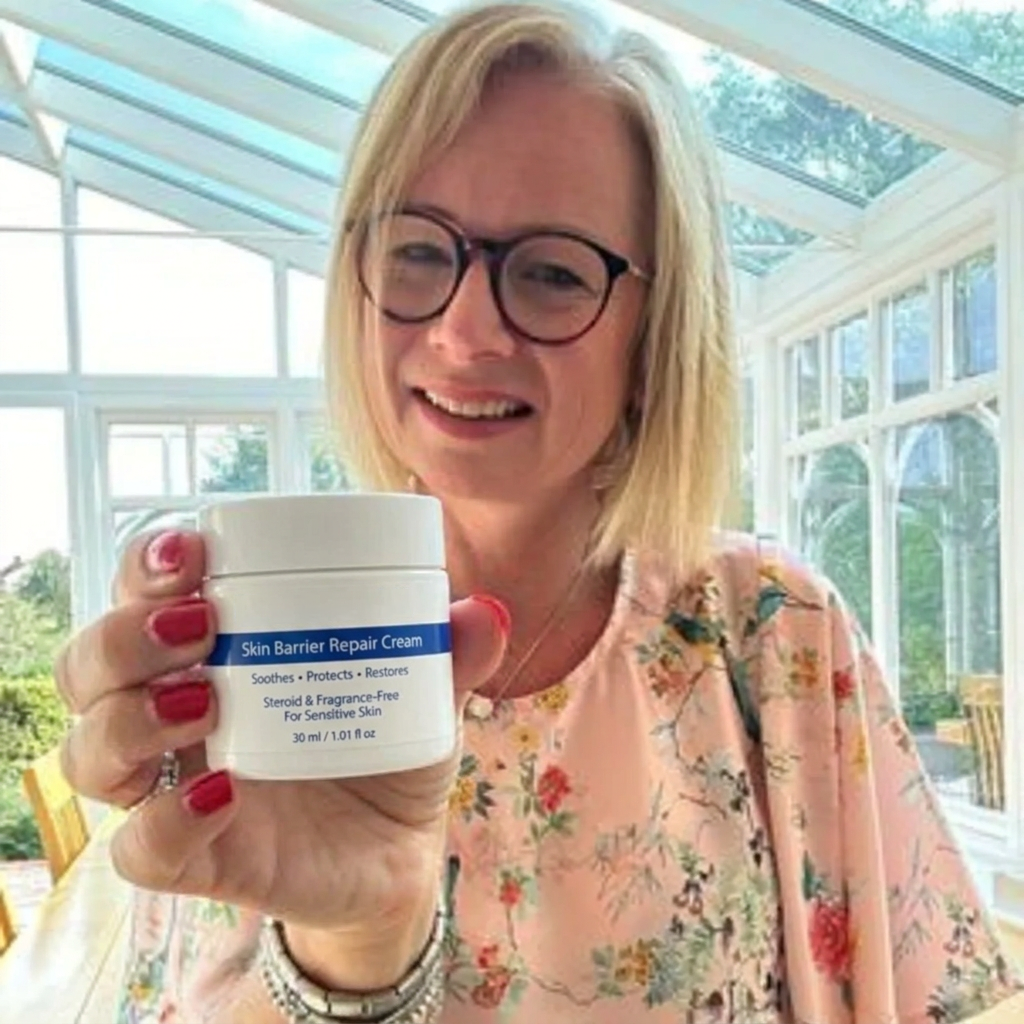
That’s why I recommend Tryskintle.
Tryskintle is a highly specialized barrier repair cream. 100% steroid-free. Fragrance-free. No prescription needed and absolutely no use limits.
And the main factor that drives my trust in the formula are the clinical active ingredients, which are specifically designed to target independent neural itching and rebuild skin architecture directly where it’s broken:
- Panthenol + Zinc Oxide: Forms an immediate, weightless, breathable physical shield that protects thinned tissue from urine, sweat, and friction while driving deep cellular repair.
- Colloidal Oatmeal: Calms the hyper-stimulated sensory nerves in delicate skin, putting the independent, self-sustaining itch-scratch loop to sleep safely.
- Aloe Vera: Cools raw, burning irritation instantly and stimulates cellular repair to thicken the thinned, damaged skin layer.
Now, the results speak for themselves. The women I’ve recommended skin barrier repair to are almost unrecognizable after just a few weeks.
The way they carry themselves, the confidence they have when walking into my office, even the little changes I notice like them wearing their regular clothing again without fear. It’s as if they finally started seeing real wins after months or years of exhausting, private maintenance routines that led nowhere.
Also, I usually hear about the exact same life-changing transformation by the time they come back to see me.
Like on week one of using the formula, when most women notice that the relentless background night itch they had normalized for months finally quiets down. That’s the first sign your independent nerve infrastructure is finally repairing itself, and micro-cuts are closing.
Or on week two, when that unmentionable, private fear of smelling or being unclean vanishes completely. The intimate skin environment shifts from a raw, weeping, leaking state back to a healthy, balanced shield.
Even by week five, when you notice that the active itching and irritation across your outer lips, perineum, and inner thighs have entirely cleared up, and they aren’t jumping anywhere else. You aren’t standing in front of bathroom mirrors checking with hand mirrors anymore, and you aren’t hiding behind tucked panty liners.
And in two months, the full 60-day barrier repair cycle, most women consider smooth, calm, and resilient intimate skin completely normal, and their intimate lives turn around completely for the better. You don’t need to rely on skin-thinning steroids, you’re not worrying your body is broken, and you finally feel like the chapter is completely closed.

Tryskintle Itching & Burning Relief
Intimate Skin Deserves Better Than A Temporary Cover-Up.
- Helps Soothe Itching & Irritation
- Supports The Natural Skin Barrier
- Helps Protect Against Moisture & Friction
- Steroid & Fragrance-Free
Your daily partner against intimate itching, burning and rashes.
TRY Tryskintle TODAYItching & Burning Relief | 60-Day Money-Back Guarantee